Hashtag Series
God’s generosity does not end with us. Across Matthew 19–20, Jesus reshapes what we have, what others receive, and what we have to give. #Enough · #Celebrate · #Overflow. Three independent Sundays, November 8–22, 2026.
Visible as the released series plan. Reading packets still require their own staff lock before download.
Series abstract, weekly alignment and team coordination guide →
#Enough
Jesus reveals that eternal life cannot be secured through possessions or human achievement. In Philippians 4, Paul describes learning contentment through Christ in both abundance and need. Our security in Christ opens the way for Spirit-worked contentment and freedom from the endless pursuit of more.
Philippians 4:10–13 · Matthew 19:16–26
#Celebrate
Recognize ourselves among grace’s undeserving recipients and rejoice when others also receive it. Psalm 67 desires joy as God’s blessing reaches all peoples; Matthew confronts the resentment that can arise when grace reaches unexpected recipients.
Psalm 67 · Matthew 20:1–16
#Overflow
Connect Christ’s self-giving to willing generosity that serves neighbors and makes ministry possible. Jesus reverses status-seeking by giving His life; Paul shows how grace received becomes willing and concrete care for others.
2 Corinthians 8:1–9 · Matthew 20:20–28
Series direction and team guide
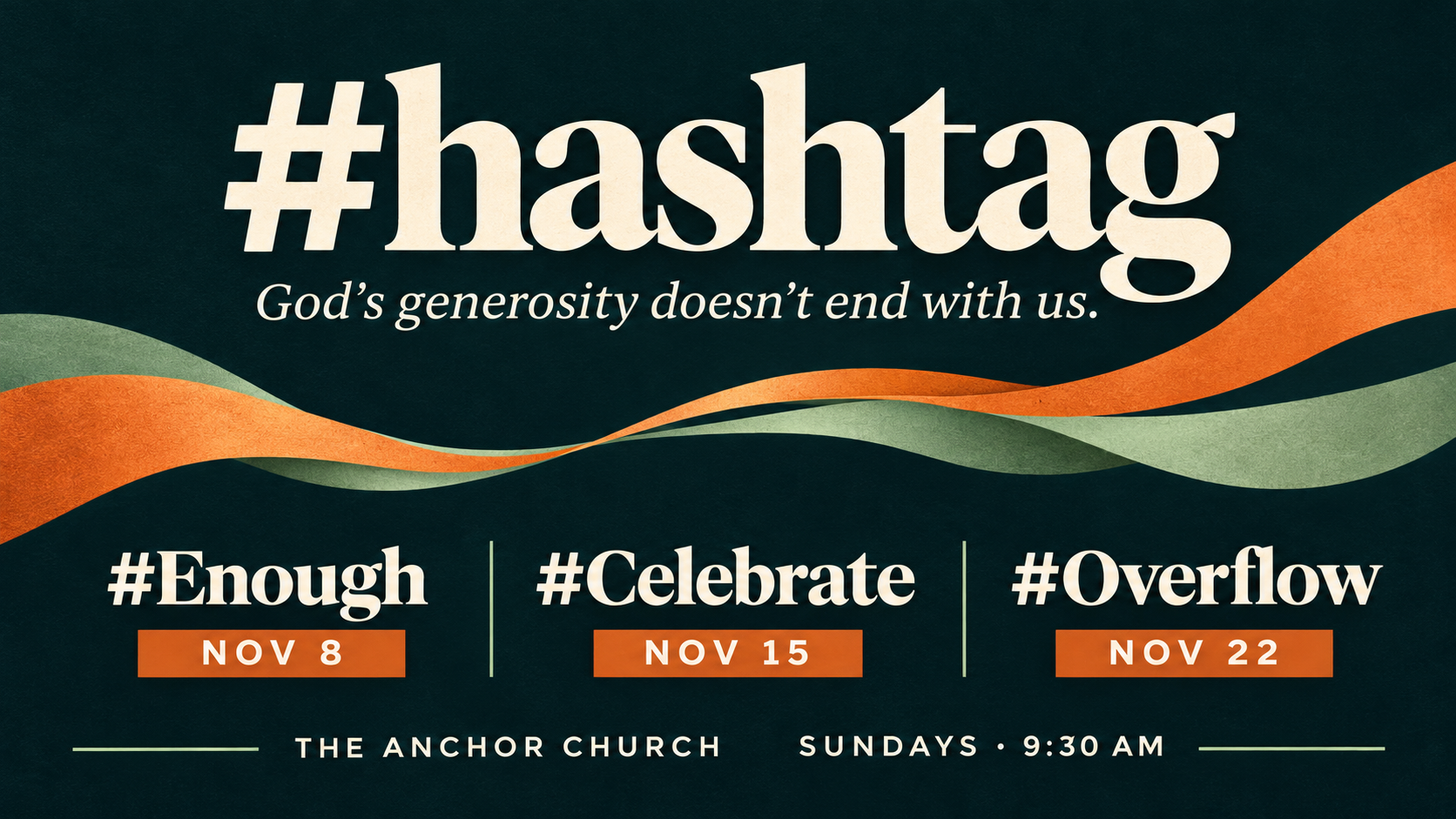
Invitation graphics and weekly messages ↗
God’s generosity does not end with us.
Three independent Sundays: #Enough · #Celebrate · #Overflow. Jesus → us → others is the shared theological foundation, not a required sermon outline.
Weekly focus, reading pairs, theme words and music direction are ready for team preparation. Final sermons, songs, kids-message creative briefs, Live Sent phrases and Scripture packet approval remain in development.
Series abstract and full weekly alignment
HASHTAG SERIES
#Enough • #Celebrate • #Overflow
Series Abstract & Weekly Alignment | The Anchor Church | November 8–22, 2026
Series Abstract
We live in a world that measures life by what we accumulate, what we deserve, and how important we appear. Across Matthew 19–20, Jesus exposes the limits of those measures and reveals a kingdom founded on God’s gift, surprising generosity, and the Son of Man who gives His life for others. These three independent Sundays invite us to receive what we cannot earn, celebrate mercy reaching beyond us, and share the gifts entrusted to us so others may be served and hear the Gospel.
Shared theological conviction God’s generosity does not end with us.
Framing question What changes when Jesus reshapes how we understand what we have, what others receive, and what we have to give?
Pastoral burden Awaken recognition of God’s gifts amid genuine scarcity and fear, soften resentment and comparison, and cultivate generous love without scolding the congregation or minimizing legitimate needs and concerns.
Know Our place in Christ is a gift; God’s kingdom reverses human calculations of wealth, merit and status, and Jesus serves and gives Himself for us.
Feel Relief from striving, gratitude for grace received, joy in mercy extended to others, and confidence to share freely.
Do Learn contentment; recognize and celebrate God’s gifts to others; practice willing, thoughtful generosity and hospitality—each as a response to grace, never as a condition of it.
Common foundation Jesus → us → others describes the theological relationship, not a required three-part outline or chronological series progression. Every Sunday must stand on its own.
Biblical Architecture
Matthew 19:16–30: A wealthy seeker asks how to obtain eternal life, and Peter asks what followers will receive. Matthew 19:30 and 20:16 frame the vineyard parable with the first/last reversal. Matthew 20:17–28 then places the disciples’ desire for honor beside Jesus’ announced suffering and His mission to serve and give His life as ransom. The narrative provides layered coherence without requiring visitors to have attended previous Sundays.
The complementary readings do different work: Philippians 4 describes contentment learned in Christ; Psalm 67 rejoices in blessing reaching all peoples; 2 Corinthians 8 shows grace taking the form of practical, material sharing among believers.
Series-wide Boundaries
Do not treat these as three behavior-correction sermons. Let the Law emerge from the text and include the preacher among those addressed. Distinguish financial insecurity and legitimate feedback from greed or resentment. Let Christ be the giver and saving actor; resurrection hope remains foundational without a required recap each week. Sanctification is the Spirit’s work and can include substantial practical teaching. Giving supports proclamation and service; money does not itself confer God’s saving gifts, which are given through Word and Sacraments. Avoid treating the landowner’s every detail as a direct policy prescription or equating a parable’s late workers literally with all Christian believers.
Calendar & Public Readings
| Sunday | Week | Theme | First Reading | Gospel |
|---|---|---|---|---|
| Nov. 8 | 1 | #Enough | Philippians 4:10–13 | Matthew 19:16–26 |
| Nov. 15 | 2 | #Celebrate | Psalm 67 | Matthew 20:1–16 |
| Nov. 22 | 3 | #Overflow | 2 Corinthians 8:1–9 | Matthew 20:20–28 |
Public readings are working selections approved for planning; reconcile with each weekly worship brief before the Scripture packet is verified or locked. Scripture translation: ESV.
Weekly Alignment
Week 1 | November 8, 2026 | #Enough
First Reading Philippians 4:10–13
Gospel Matthew 19:16–26
Distinct purpose Secure in Christ, we can learn contentment instead of defining life by more.
Scriptural conversation Matthew asks what can secure eternal life; Philippians testifies to Christ-sustained contentment in circumstances that fluctuate.
Human reality A culture of more promises that another possession, achievement, or guarantee will finally make us secure.
Law (provisional) We trust possessions, achievement, and control to give the life and security they cannot provide.
Gospel (provisional) Jesus exposes our inability to save ourselves and announces that what is impossible for us is possible with God; Paul witnesses to Christ sustaining His people in plenty and in need.
Possible turn (not final sermon line) What we cannot obtain or secure by our own effort, God alone gives.
Grace-born formation Explore learned contentment: naming enough, distinguishing needs from endless comparison, prayer and receiving daily gifts without making practices conditions of grace.
Emotional register Searching, then freeing and reassuring
Image territory An open hand; possessions that cannot hold life
Kids Gospel thread Jesus gives us what we cannot earn; our lives are safe in His care even when we do not have everything we want.
Research bank / context Matthew 19:27–30 (Peter and reward); Luke 12:22–34 (Father’s care); Psalm 23 (Shepherd); Philippians 4:4–9 (prayer and peace).
Sermon challenge / Live Sent To be discerned independently during weekly sermon and worship planning; do not use a predetermined action step or confuse the two moments.
Week 2 | November 15, 2026 | #Celebrate
First Reading Psalm 67
Gospel Matthew 20:1–16
Distinct purpose Recognize ourselves among grace’s undeserving recipients and rejoice when others also receive it.
Scriptural conversation Psalm 67 desires joy as God’s blessing reaches all peoples; Matthew confronts the resentment that can arise when grace reaches unexpected recipients.
Human reality It is hard to celebrate when someone else receives a gift we would not have chosen or think they deserve.
Law (provisional) We forget that we are recipients of mercy and act as if our service or history gives us a stronger claim than the latecomer.
Gospel (provisional) Jesus reveals the kingdom’s unexpected generosity. Our place is gift, not wage earned by superiority; mercy given to others does not diminish mercy given to us.
Possible turn (not final sermon line) We are guests of the same generosity that surprises us when it reaches another.
Grace-born formation Practice seeing and celebrating God’s gifts to others; make room for newcomers and celebrate those who receive care without denying legitimate questions about stewardship.
Emotional register Bright and celebratory, with a searching reversal
Image territory The vineyard; an unexpected invitation to share joy
Kids Gospel thread Jesus welcomes people by grace; His kindness to someone else never means He has less love for you.
Research bank / context Matthew 19:27–30 (context of reward); Isaiah 55:1–3 (free invitation); Luke 15 (recently preached; only as optional comparison).
Sermon challenge / Live Sent To be discerned independently during weekly sermon and worship planning; do not use a predetermined action step or confuse the two moments.
Week 3 | November 22, 2026 | #Overflow
First Reading 2 Corinthians 8:1–9
Gospel Matthew 20:20–28
Distinct purpose Connect Christ’s self-giving to willing generosity that serves neighbors and makes ministry possible.
Scriptural conversation Jesus reverses status-seeking by giving His life; Paul shows how grace received becomes willing and concrete care for others.
Human reality We can define a rich life by status, control, and what remains safely in our hands.
Law (provisional) We seek to be served and secure our own standing, and can make generosity transactional or reluctant.
Gospel (provisional) The Son of Man came to serve and give His life as a ransom. God’s grace makes us recipients first, then participants in meeting others’ needs.
Possible turn (not final sermon line) We do not give to obtain grace; Christ gives Himself for us, and His love frees us to serve.
Grace-born formation Teach thoughtful, willing and proportionate generosity in financial giving, welcome, time, practical service and community connection; reject pressure on those in hardship.
Emotional register Christ-centered, inspiring, practical and outward-facing
Image territory Hands receiving and sharing, not a fundraising thermometer
Kids Gospel thread Jesus served and gave Himself for us; His love helps us share what we have with others.
Research bank / context 2 Corinthians 8:10–15 and 9:6–15 (willingness, capacity, thanksgiving); Matthew 20:17–19 (suffering prediction); Psalm 67 (blessing reaching others).
Sermon challenge / Live Sent To be discerned independently during weekly sermon and worship planning; do not use a predetermined action step or confuse the two moments.
Series-level Worship & Team Texture
Visual identity: bold, contemporary hashtag typography (#Enough, #Celebrate, #Overflow), consistent across all three Sundays; use distinct visual textures for security/contentment, shared joy, and generous service. Avoid coins piled high, abundance-as-prosperity imagery, guilt-driven donation graphics, and literal vineyard imagery on every slide. A recurring subtle first/last echo may appear when it serves the text.
Worship tone: #Enough—thoughtful, searching, confident in Christ; #Celebrate—bright, joyful, expansive; #Overflow—grateful, servant-hearted, outward-looking. Songs should proclaim Christ’s gifts and promises, not simply echo hashtag words. Communion consistently delivers Christ’s gifts; do not make it a metaphor for earning participation.
Series context: November 29 begins Advent and is also Community Sunday. Week-specific songs, hosts, reader assignments, sermon outlines, slides, children’s creative briefs and Live Sent phrases remain in their respective weekly workflows.
Research & Development Status
Ready for team use: dates, hashtags, Matthew 19–20 biblical center, working public reading pairs, series direction, weekly focus and broad Law/Gospel lanes. Still developing: final sermon threads/structures, deeper exegesis, illustrations/verified quotes, kids-message creative briefs, weekly worship specifics, song selections and Live Sent phrases. Recent-use note: Luke 15’s lost sheep, coin and son were preached in the last 18 months and are intentionally not primary readings for this series. Luke 12 / Matthew 6 teaching on anxiety has substantial thematic overlap with recent preaching.
The Anchor Church | Hashtag Series | November 2026
Series team coordination guide
THE ANCHOR | NOVEMBER 2026
HASHTAG
Series Team Coordination Guide
Three responses awakened by the generosity of Jesus | November 8–22, 2026
SERIES TENSION What changes when Jesus reshapes what we have, what others receive, and what we have to give?
Series direction Matthew 19–20 challenges our assumptions about possessions, merit, and greatness while revealing God’s gift, surprising generosity, and Christ’s self-giving service. In three independent Sundays, we receive grace, learn contentment, rejoice as grace reaches others, and share willingly so neighbors can be served and hear the Gospel.
Working series bottom line God’s generosity does not end with us.
Series Calendar
| Sunday | Week | Theme | First Reading | Gospel |
|---|---|---|---|---|
| Nov. 8 | 1 | #Enough | Philippians 4:10–13 | Matthew 19:16–26 |
| Nov. 15 | 2 | #Celebrate | Psalm 67 | Matthew 20:1–16 |
| Nov. 22 | 3 | #Overflow | 2 Corinthians 8:1–9 | Matthew 20:20–28 |
After this series: Nov 29 — First Sunday of Advent and Community Sunday (potluck after worship).
Series-level scope This guide coordinates dates, weekly themes, primary reading references, and preparation direction. Do not include individual Sunday assignments; maintain those in the weekly worship brief and team site.
Reading source The First Reading and Gospel references in this guide must match the weekly brief. An authorized reviewer must resolve any discrepancy before a reading packet is generated, verified, or locked.
Weekly Direction
These are planning anchors, not sermon scripts. Give readers, kids-message leaders, worship planners, and communications one shared picture of where each Sunday is headed.
WEEK 1 - NOVEMBER 8, 2026
#Enough
Philippians 4:10–13 | Matthew 19:16–26
Weekly focus The wealthy man cannot find life through possessing or achieving; Jesus exposes the impossibility of securing salvation on our own and points to what God alone makes possible. Paul helps us see contentment as learned dependence on Christ in both plenty and need.
Theme words Christ our treasure • contentment • kingdom • dependence • enough • freedom
Music direction Move from honest need and dependence toward confidence in Christ as our true treasure and strength.
WEEK 2 - NOVEMBER 15, 2026
#Celebrate
Psalm 67 | Matthew 20:1–16
Weekly focus The landowner’s generosity exposes how easily comparison turns a received gift into a grievance. Psalm 67 invites us to rejoice when God’s blessing reaches beyond us; we are recipients of unearned grace, yet can act as though we have worked the whole day.
Theme words grace • kingdom • latecomers • joy • welcome • blessing for all
Music direction Celebrate the wideness of God’s mercy, the joy of belonging, and gratitude that expands toward neighbors rather than turning inward.
WEEK 3 - NOVEMBER 22, 2026
#Overflow
2 Corinthians 8:1–9 | Matthew 20:20–28
Weekly focus While disciples seek status, Jesus reveals greatness through serving and gives His life as a ransom. Paul describes communities sharing generously because grace has reached them; what we receive from Christ becomes care, connection, and opportunity for others to receive His gifts.
Theme words Christ gives • serve • sharing • connection • generosity • neighbors
Music direction Center Christ’s humble self-giving and move into thankful, free, outward-looking service and joyful generosity.
How Each Team Can Use This Guide
Readers
• Primary reading references are stable enough for readers and worship planners to begin preparation.
• The First Reading is listed before the Gospel. The Gospel remains the final Scripture reading in worship.
• The series guide and weekly brief must agree before packet generation. Do not change a reference without coordinating with the preaching and worship team.
Kids Message Team
• Use the weekly focus and readings to begin Kids Message preparation; individual host assignments appear only in the weekly brief and team site.
• Weekly kids-message briefs will keep Jesus and what He gives first, express Law/Gospel clearly, and invite age-appropriate faith and love rather than moralistic performance.
• Object ideas and take-home phrases can continue developing within the weekly Kids Message brief.
Praise / Worship Team
• Use the weekly focus and theme words as direction, not as a requirement that every song literally match the sermon title.
• Prioritize the Gospel movement of the week: what Christ has done, gives, promises, or restores.
• Use each week's focus and theme words to identify the Gospel movement, emotional tone, and preparation needs without turning this guide into a required song list.
Communications Team
• Dates, hashtags, reading pairs and weekly focus are ready for planning and promotion; exact public-reading references must match the approved weekly briefs before packets are locked.
• Use clear contemporary hashtag typography with three distinct weekly moods; avoid gimmicky social-media imagery, prosperity imagery or pressure-based giving messages.
• Working promotional tension / hook: “What changes when we see life through the generosity of Jesus?”
What Is Locked / What Is Still Developing
READY TO USE NOW
STILL IN DEVELOPMENT
• Dates and weekly hashtags
• Matthew 19–20 foundation
• Working First Reading and Gospel pairs
• Weekly focus and theme words
• Series theological center
• Final sermon threads, notes and slides
• Supporting Scriptures and illustrations
• Kids Message creative briefs
• Songs and weekly service details
• Assignments (weekly briefs/team site)
• Scripture packet approval and lock
Series Team Coordination Guide